
Influential Firearms You’ve Never Heard Of, Part 1: Steyr M
Introduction
Nihil sub sōle novum—there’s nothing new under the sun. Rarely does a firearm enter production whose design relies on a completely novel idea; all take features from existing designs and re-engineer them according to specific constraints. Everyone knows, for example, that almost every semi-automatic centerfire pistol on the shelf at your local gun store uses the same short-recoil, tilting-barrel action pioneered by John Browning more than a century ago and perfected on the SIG P220 in 1975. The AK family of rifles bears a striking similarity in the design of its gas system, bolt, and trigger group to the M1 Garand; et cetera, et cetera. Once one engineer has figured out a design element that works well, there’s little reason for anyone else to re-invent the wheel, or in this case, the rotating bolt.
We all recognize the influence of the M1911, the AR-15, the Glock 17, and the Colt Walker on successive generations of designs, but more than a few firearms have had outsized impact while themselves falling into the dustbin of history. These, to paraphrase Law and Order, are their stories.
Criteria
To qualify for this series of blog posts, a firearm must be significant from an engineering perspective but obscure in the popular consciousness. More specifically, each entry on this list was unsuccessful for some reason but featured some innovative design element that would go on to be adapted in other firearms which greatly overshadowed the original. In short, anything that makes the list must be innovative, influential, and obscure.
The SVT-38, for example, while hugely important in the progression of gas-operated firearm design, didn’t make the cut because it is too well known. None of Emilio Ghisoni’s designs qualified either because, despite their mechanical uniqueness and near-total obscurity, Ghisoni’s innovations unfortunately failed to catch on.
Steyr M: The Pistol of the 21st Century
What It Is
The Steyr M family is a series of polymer-framed, striker-fired, semi-automatic pistols offered in a variety of sizes and calibers denoted by each variant’s designation. Unlike future entries in this series, the Steyr M is still in active production, and if you live outside California, you can buy one right now. Currently, Steyr offers three models in the United States: the compact C9-A2 MF, the mid-size M9-A2 MF, and the full-size L9-A2 MF.
Why It Matters
Along with optics mounting, modularity has been one of the hottest trends in pistol design over the past several years. The P320 was made famous by, among other things, its removable serialized fire control unit and the Modular Handgun System contract that feature enabled, but it is far from the only pistol with that particular design element. The Beretta APX, Springfield Echelon, Ruger RXM, ZEV OZ9, and others offer the same capability, though the last two are admittedly just redesigned Glocks. Sig Sauer didn’t invent the fire control units, though, and neither the P365 nor the P320 nor even the P250 were the first pistols to have them. For years before Sig Sauer unveiled their first modular pistol, famed Austrian manufacturer Steyr had already been manufacturing the M series.
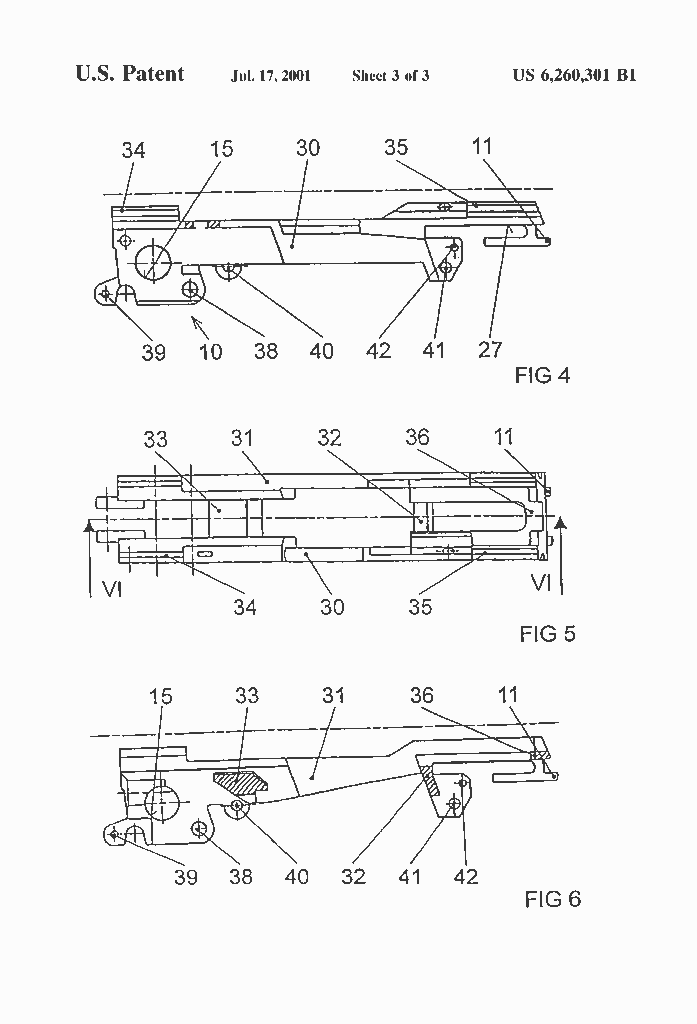
Filed in Austria in 1998 and in the United States one year later, Steyr Mannlicher holds the original patent for the unitized pistol fire control assembly. U.S. patent 6,260,301 B1 describes a system invented by Steyr engineers Friedrich Aigner and Wilhelm Bubits consisting of “a single multifunction part, which is composed of metal… inserted removably into the housing [frame], on which… the guides [rails] for the barrel slide are formed and in which the elements of the trigger mechanism are mounted and guided.” Sound familiar? That isn’t just a coincidence—Sig Sauer ripped off the design for their P250, which evolved into the P320, but a lawsuit by Steyr failed on a technicality based on the placement of pin holes.
Why You’ve Never Heard of It
Even though you can buy a Steyr M right now, most people don’t. Where Sig Sauer has succeeded in offering a wide variety of replacement P320 and P365 grip modules and uppers, as well as promoting the same in the aftermarket, Steyr has spent two and a half decades utterly failing to capitalize on bringing to market the first-ever “modular” pistol. Without that selling point, the pistol has never had any truly compelling advantages over similar offerings. Additionally, the Steyr features an unusual grip angle, an even more unusual trapezoidal sight arrangement, and on early models, a bizarre manual safety located inside the trigger guard. The M also came out hot on the heels of the Gen 3 Glocks; most customers looking for high-quality pistols in that market segment would have gone with the more popular of the two Austrian brands instead.
It really is too bad that Steyr didn’t offer replacement grip modules in different sizes and with different grip angles, because I think they could have had a winner with the M family. The design isn’t a total failure, though; it’s clearly sold well enough to remain on the market for more than a quarter-century. Wilhelm Bubits, one of its inventors, later went on to work for UAE-based firearm manufacturer Caracal. If you look at a Caracal F, you’ll notice some Steyr DNA in there: the frame is shaped to promote a high grip and create a low bore axis, just like the Steyr M.